In a way with Vivi, it feels like we speedran being authentic — we showed each other the inside of our heads, and thought about what it’d be like to live in there. In previous early dating experiences I’d almost subconsciously try to impress them in some way; whether with career, stories of interesting life experiences, etc. I found it to be almost the complete opposite with Vivi. We’d spill out our deepest insecurities and fear. And the surprising part is that every time we did, it felt like instead of being put off, we’d appreciate each others’ presence even more. We’ve pretty much only talked for the past week, and yet I’m quite completely trusting in her continued liking of me (and I hope, vice versa.)
But I know that literally everyone falling in love says something along the lines of “oh I’ve never connected with someone on that level” or “this is something completely different” every time, and it can’t always be true. It’s probably some neurochemical con job. But do I really care?
On a slightly less bullish side, I find it hard to get a feel of what she wants out of life. She isn’t someone to think far ahead — that’s part of her worldview, I get it. She wants to live in an isolated farmhouse on a massive grass field in the Netherlands. I’d be down for that. But she also has a plan to “expire” at twenty? With a casket and funeral prepared?! I’m kind of impressed at the agency, but I’m really surprised. She herself says she has a great life, but that she doesn’t see a point in continuing it after that. I know I’m an idiot for saying “i can fix her” and playing into the meme, but well and truly, what?! Feel like there has to be more discussion. But really, at eighteen, how much could one have seen? There’s so much vastness and beauty in life. I care a lot about my longevity more than anything after having seen more of the world. In some ways I hope she’s the same, but I’ll understand more after clarifying her motivations.
We also talked a bit about who pays. I feel pretty obligated to pay when there’s a massive income disparity — generally, I try to pay for everyone who’s still in college. I care a lot about feeling responsible and needed, so I usually psyop them with some explanation of consumption smoothing. I genuinely do believe in consumption smoothing utility-wise, but also, I don’t embrace it in my personal finances. I obsessively save every penny because every penny brings me closer to my freedom; I spend only to the degree of which it helps me make more money. Consumption smoothing is purely to convince other people to let me pay (because it does make utilitarian sense, but also because it makes me feel needed/responsible, so it’s positive sum anyways).
I was talking with some guy (Tristan) who was a late 20’s school teacher at Saturday night Sunridge Badminton Club. He asked me if I thought I was a good person. I said that it was almost impossible to define — what would make me a good person? Is it that I donated to charity? Is it that I’m not selfish? Is it that I’m empathetic? Generous? Loyal? Respectful? Accountable? Kind? Patient? Everyone thinks that they’re a good person. It’s a complicated term to define, and even harder to achieve.

I think the thing that I really value about having a dog is that it’s pretty easy to be a good dog owner. The guidelines are clear: you feed your dog, you take your dog on lots of walks, you play with your dog, you don’t leave your dog alone very much. I know that I take good care of my dog. With people, however, it’s a different story. Because people are so impossibly complex. I’m always wondering if I’m a responsible partner, a responsible friend. There are guidelines for these roles, and I think I follow them decently well, but obviously there’s a lot of murkiness. I love my candid friends who give me a small nudge when I do something out of line, but also, they can’t be watching over my every interaction (nor is it healthy to live completely by someone else’s compass). In general, for most social things, it feels best to trend towards the median rather than someone else’s opinions. It seems clear that in a friendship, your responsibility is to be reasonably responsive, make time for your friend, and support them when you can. If you’re very close to them, the responsibilities are significantly more, and if you’re not close, the responsibilities are less. But let’s say someone wants to stop being friends with me. Is it okay for them to do that? Obviously they can do whatever they want… but to what degree can I expect it to be sustained? I really didn’t realize this was an insecurity I had until today. I thought I’d never brought it up but apparently I did, three whole years ago.
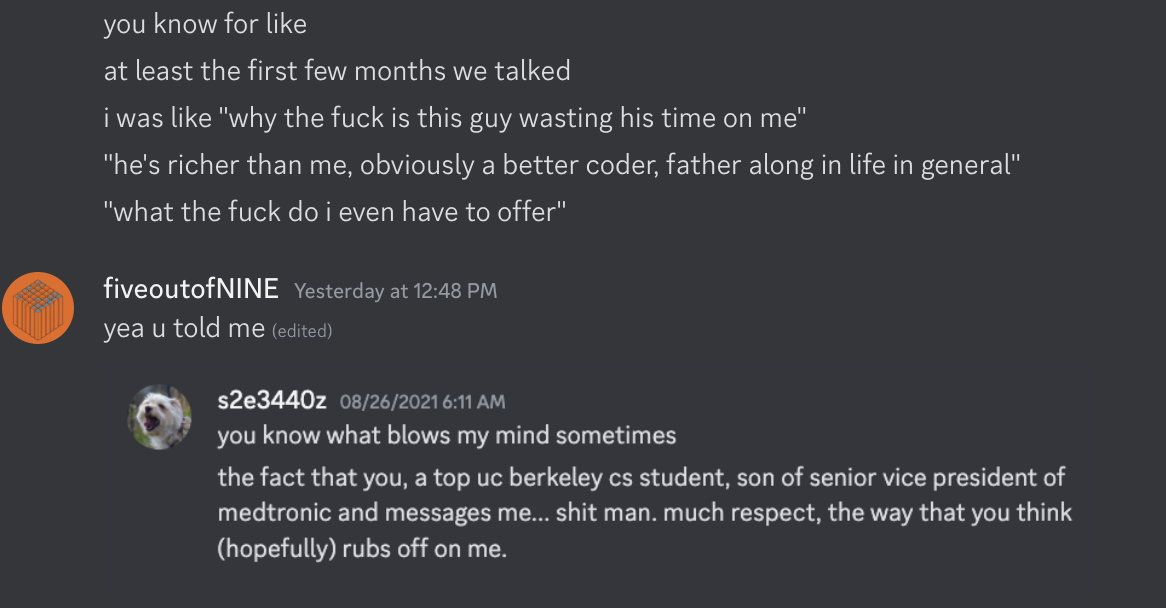 a very social status/transactional view and I don’t value my friendships like this, but it still felt murky for a while
Some people, perhaps even many people, would say that our only responsibility is to our own happiness. Other people would say that we are ethically bound to take into account other people’s feelings. There’s a part of me that so badly wants to do everything right. But what if no one can tell you what the right answer is?
I saw some tweet a while back that said something along the lines of “don’t be afraid to be needy, because some people need to feel needed.” I’m one of the people who needs to feel needed — maybe even one of my basic emotional needs. For the first 18 years of life, this means being your parents’ child and giving them purpose; one doesn’t have to put any explicit effort into this, yet it’s reflected in a child’s desire to please their parents. It’s symbiotic; you need them, but in some way, they also need you. Then, as you become of age, and try and be more independent, it’s a tough transition — do you feel needed at your job? Or maybe at university, “making your parents proud” is still a way of feeling needed? But what happens when these things end? I have a theory that it’s a major cause of senior depression/suicide — that after feeling needed for 60+ years, they finally have time to themselves.
When I was on leave at Blowfish, I had a major needed-ness crisis. I wasn’t Sudolabel the ungodly scam preventing whiz. I was just some kid sitting at his desk. It was probably the biggest identity crisis I’d ever had in my life. I’ve thought about being needed a lot since. I really don’t know why I feel this way. Is it a deep fear of abandonment? Is it a deep love for my own competency and agency?
Not sure why but this song captures my mood fairly well today: https://open.spotify.com/track/5kSBstWdaP3tMlArgGM00C?si=2bc071b92f9e4f45
I really don’t know what I expect anyone to get out of this journal. Part of it is my own emotional regulation. I think it does a good job of that. But who’s going to read it? Nobody (myself included) will probably ever relate to the emotions ever again. It’s so so so many words. Part of me hopes that it’s a bit of a peek into my brain. I don’t know why that would be remotely valuable, however.